Understanding the Impact of Disabled Man Drawing Vector Illustration
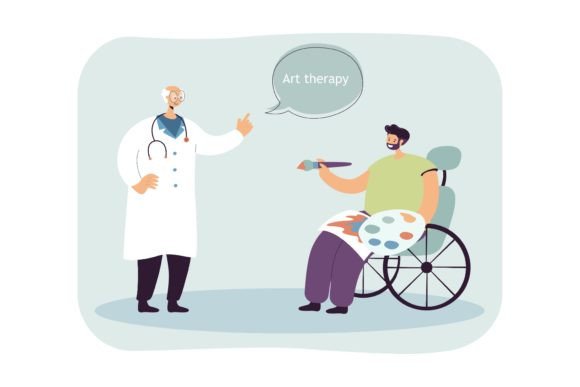
In the realm of digital design and visual storytelling, specific imagery often carries more weight than generic stock photography. The Disabled Man Drawing Vector Illustration has emerged as a powerful asset for designers seeking to convey narratives of resilience, therapeutic intervention, and creative triumph. Unlike standard photographic representations which can sometimes feel staged or overly dramatic, this vector format offers a stylized, clean, and universally understandable depiction of a male figure in a wheelchair, deeply engaged in the act of painting, often accompanied by a supportive medical professional.
This specific illustration style is distinct because it moves beyond simple representation to explore the intersection of disability, art therapy, and human connection. It captures a moment of focus and determination, transforming the subject from a passive recipient of care into an active creator. For businesses, non-profits, and healthcare providers, understanding the nuances of this visual tool is essential for crafting messages that resonate authentically with audiences aged 20 to 50 who are increasingly sensitive to issues of inclusion and mental well-being.
Defining the Visual Language of Resilience
The core appeal of the Disabled Man Drawing Vector Illustration lies in its ability to distill complex emotional states into clear, scalable graphics. In this composition, the primary subject is a man seated in a wheelchair, surrounded by paints and brushes. His posture suggests immersion in his work, while the presence of a doctor or therapist nearby serves not as a barrier, but as an encouraging catalyst. This dynamic interaction is crucial; it shifts the narrative from one of limitation to one of collaboration and support.
Vector illustrations differ fundamentally from raster images (like JPEGs or PNGs) in their construction. They are built using mathematical paths rather than pixels, allowing them to be resized infinitely without losing quality. This technical advantage makes the Disabled Man Drawing Vector Illustration particularly versatile for modern web design. Whether the image needs to be displayed on a small mobile screen or a large desktop banner, the lines remain crisp and the colors vibrant. This scalability ensures that the message of courage and creativity remains sharp regardless of the viewing context.
Furthermore, the stylistic choices inherent in vector art—such as flat design, limited color palettes, and simplified forms—help reduce visual clutter. This allows the viewer to focus immediately on the emotional core of the image: the man's engagement with his art and the supportive presence beside him. The absence of photorealistic details forces the audience to project their own interpretations onto the scene, often making the message of overcoming adversity feel more personal and less prescriptive.
Comparing Vector Illustrations with Photographic Alternatives
When evaluating visual assets for websites, landing pages, or marketing materials, designers often weigh vector illustrations against high-resolution photography. While photography offers realism, it comes with significant tradeoffs regarding cost, licensing, and authenticity. A photograph of a disabled artist requires a professional photoshoot, model releases, and careful direction to avoid clichés. Even then, there is a risk that the image may appear staged or exploitative if the nuance is lost.
In contrast, the Disabled Man Drawing Vector Illustration provides a controlled environment where every element serves a specific narrative purpose. Designers can adjust the lighting, the expressions, and the positioning of the doctor and patient to ensure the interaction feels genuine and empowering. This level of control is difficult to achieve with photography. Additionally, vector files are significantly smaller in file size compared to high-res photos, leading to faster page load times—a critical factor for user experience and search engine optimization.
However, photography does have its place. If the goal is to document a real event or showcase a specific individual's story, a photograph is irreplaceable. The Disabled Man Drawing Vector Illustration is best suited for conceptual messaging, branding, and educational content where the focus is on the idea of art therapy rather than a specific person. It acts as a universal symbol, whereas a photograph anchors the story to a specific time and place. Understanding this distinction helps organizations choose the right medium for their communication goals.
Strengths and Limitations of the Vector Format
The strengths of using a Disabled Man Drawing Vector Illustration are multifaceted. First, the adaptability of the format allows for easy customization. Colors can be changed to match brand guidelines, and elements can be isolated or rearranged to fit different layout requirements. Second, the illustrative style tends to age better than photography; trends in fashion and photography styles change rapidly, but a well-designed vector icon or character often remains relevant for years.
Despite these advantages, there are limitations to consider. Vector illustrations lack the texture and depth of reality, which can sometimes make them feel too abstract for campaigns requiring deep emotional vulnerability or raw authenticity. If an organization wants to highlight the gritty, unpolished reality of living with a disability, a stylized vector might feel too sanitized. Additionally, the effectiveness of the illustration relies heavily on the skill of the artist. Poorly executed vectors can look cheap or cartoonish, undermining the serious nature of the topic.
Another consideration is the potential for overuse. As inclusive imagery becomes more common, there is a risk that certain tropes become repetitive. The image of a disabled person being "saved" or "inspired" by art is powerful, but it must be handled with care to avoid reinforcing paternalistic narratives. The presence of the doctor in the Disabled Man Drawing Vector Illustration should be framed as partnership rather than dependency to maintain the integrity of the message.
Strategic Use Cases and Decision Factors
Determining when to utilize a Disabled Man Drawing Vector Illustration depends largely on the intended platform and the desired emotional response. This type of asset is exceptionally effective for website headers, landing pages for rehabilitation centers, and banners promoting art therapy programs. Its clean lines and clear symbolism make it ideal for conveying information quickly to users scanning a page.
For example, a hospital looking to promote its new occupational therapy wing might use this illustration to signal a welcoming, creative environment. The image suggests that the facility values patient agency and holistic healing. Similarly, a non-profit focused on mental health could use the graphic to illustrate the benefits of creative expression without needing to show vulnerable patients in distressing situations.
Conversely, there are scenarios where alternative options may be more appropriate. If the campaign involves fundraising based on personal testimonies, real photographs of the beneficiaries are likely to generate a stronger emotional connection. Similarly, for internal training materials that require detailed anatomical accuracy or realistic depictions of medical equipment, a schematic diagram or a high-quality photo would be superior to a stylized vector.
Decision-makers should also consider the technical constraints of their project. If the design team lacks the skills to manipulate vector files (using tools like Adobe Illustrator or Inkscape), they may find the flexibility of the format less useful. In such cases, pre-made raster versions or simpler icon sets might be more practical. However, for most modern web projects, the long-term benefits of owning a scalable, editable vector asset outweigh the initial learning curve.
Evaluating the Narrative Depth of Art Therapy Concepts
Beyond the technical specifications, the true value of the Disabled Man Drawing Vector Illustration lies in its narrative depth. It encapsulates a story of interaction between the patient and the caregiver, highlighting the therapeutic relationship. This is a subtle but vital distinction from images that depict disability in isolation. By including the doctor as an encouraging figure, the illustration reinforces the idea that recovery and self-expression are collaborative processes.
This approach aligns with contemporary understandings of mental health and physical rehabilitation, where patient empowerment is central. The image invites viewers to see the disabled individual not as a case study, but as a creator. This shift in perspective is crucial for reducing stigma and fostering empathy. When used correctly, the illustration serves as a visual bridge, connecting the audience to the profound utility of art therapy in overcoming adversity.
Ultimately, the choice to use a Disabled Man Drawing Vector Illustration should be guided by a desire to communicate respect, capability, and hope. It is a tool that, when wielded with intention, can transform a static webpage into a dynamic space for reflection and inspiration. By balancing aesthetic appeal with a thoughtful message, designers can create experiences that honor the spirit of triumph found in the journey of healing through art.